Sunday, December 26, 2010

Digital Visual artist

Digital art

Digital art is a general term for a range of artistic works and practices that use digital technology as an essential part of the creative and/or presentation process. Since the 1970s, various names have been used to describe the process including computer art and multimedia art, and digital art is itself placed under the larger umbrella term new media art.

The impact of digital technology has transformed traditional activities such as painting,drawing and sculptor, while new forms, such as net art, digital installation art, and virtual reality, have become recognized artistic practices. More generally the term digital artist is used to describe an artist who makes use of digital technologies in the production of art. In an expanded sense, "digital art" is a term applied to contemporary art hat uses the methods of mass production or digital media.

http://en.wikipedia.org/wiki/Digital_art

Digital visual artist

Bobby Chiu, Canadian

Digital painter Bobby Chiu got his start designing Disney, Warner Bros. and Star Wars toys and that playful, imaginative tone remains in his illustration work for film and television today. Chui teaches digital painting at Schoolism.com and has won a number of CG Choice Awards from the CG Society of Digital Artists.

Of his choice to work with digital rather than traditional materials, Chui told It's Art Magazine, “When I experimented a bit with Illustrator and Photoshop 3 I quickly realized that ‘digital’ will be the way to go in the near future. With digital art there is no need to buy paint or canvases and you can take your art with you to work on almost anywhere. You can’t do that using traditional materials.”


Cristiano Siqueira, Sao Paulo / Brazil,

Cristiano Siqueira, known as CrisVector, is a digital artist from Brazil who uses vectors, Photoshop and 3D to create his unique artwork. A former graphic designer, Siqueira was itching for a bit more creative freedom, which he has found now as a self-employed illustrator.

Siqueira told Abduzeedo “All my illustrations are done entirely digitally I usually use 3 basic techniques: digital composition, digital painting and vectorial illustration. These techniques blend with each other many times, I may use composition elements on a painting (pictures insertion, for exemple), using vectorial elements in a composition or using digital painting elements in a vector illustration.”

http://weburbanist.com/2009/09/28/digital-painters-old-world-art-meets-modern-tech/

Saturday, December 25, 2010

Friday, December 24, 2010

Happy/joy

· Happy/joy

Definition: Happiness is a state of mind or feeling characterized by contentment, love, satisfaction, pleasure, or joy. A variety of biological,psychological,religious, and philosophical approaches have striven to define happiness and identify its sources.

While direct measurement of happiness presents challenges, tools such as The Oxford Happiness Questionnaire have been developed by researchers. Positive psychology researchers use theoretical models that include describing happiness as consisting of positive emotions and positive activities, or that describe three kinds of happiness: pleasure (positive sensory experience), engagement (involvement with one’s family, work, romance and hobbies), and meaning (using personal strengths to serve some larger end).

Research has identified a number of attributes that correlate with happiness: relationships and social interaction, extroversion, marital status, employment, health, democratic freedom, optimism, endorphins released through physical exercise and eating chocolate, religious involvement, income and proximity to other happy people. Happiness is mediated through the release of so-called happiness hormones.

Cause

  • The level of happenings or experiences in one's life:
    things, events, experiences that trigger inner happiness to flow
  • The level of physiological biochemical in the body:
    a subtle substance known as OJAS
  • The non-physical level at the source of life:
    the nature of life itself is what causes happiness to want to flow and expand

Sad

· Sad

Definition: Sadness is an emotion characterized by feelings of disadvantage, loss, helplessness, sorrow, and rage. When sad, people often become outspoken, less energetic, and emotional.

Sadness can be viewed as a temporary lowering of mood, whereas depression is characterized by a persistent and intense lowered mood, as well as disruption to one's ability to function in day to day matters.

Cause

Loss is the most common cause of sadness. It's a very sad thing to lose someone or something that you care about. There are many kinds of loss. The death of a relative, friend, or pet can bring weeks or months of sad feelings. Other kinds of loss can also bring sadness, like people close to you getting a divorce or moving to a new town and leaving old friends. With this sadness, you might also feel angry or guilty, like you may have caused the loss - but you probably did not. Sometimes it is hard to think straight because you cannot get your mind off your loss. Usually, the load of sadness you carry after a loss will lighten over time, although there may always be a little bit of sadness left.

Relationships bring happiness and fun most of the time, but they can also bring sad times. Many kids fight with family members, especially their parents, in the struggle to grow up and gain independence. They fight about things like money, clothing, haircuts, school, friends, and cars. In school, problems with teachers and grades may cause periods of sadness as well. Other kids, both friends and enemies, can cause hurt feelings and sadness through fighting, teasing, peer pressure, not giving you support, or leaving you out of group activities.

Self-image, the way you feel about yourself, can be a big reason for sad feelings. Most people, even adults, are not completely happy with the way they look. Many people feel that they are not as good as they would like to be in sports or in school. And lots of people feel shy when talking to other people (especially with members of the opposite sex).

Jealousy

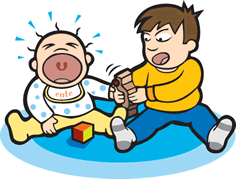
Definition: Jealousy is an emotion and typically refers to the negative thoughts and feelings of insecurity, fear, and anxiety over an anticipated loss of something that the person values, such as a relationship, friendship, or love. Jealousy often consists of a combination of emotions such as anger,sadness and disgust. It is not to be confused with envy.

Jealousy is a familiar experience in human relationships. It has been observed in infants five months and older. Some claim that jealousy is seen in every culture; however, others claim jealousy is a culture-specific phenomenon.

Cause

It starts when:

  • You determine yourself worth based on your possessions, status, or looks.
  • You feel "entitled" because of something that's happened to you somewhere along the way.
  • You have feelings of insecurity or low self esteem.

You can't completely eliminate the cause of jealousy, but there are some things that can help control it:

1. Stop comparing yourself to everyone else. God's plan for you is completely different than His plan for someone else. You may be "in training" for something God has in mind for you. But as long as you waste your time comparing yourself to others, you'll never move forward.

2. Know that where you are is where you need to be. As long as you remain focused and upset about where you're not, God won't put you anywhere else.

3. Start focusing your time on what you can do for other people.When the revelation finally hits you, "it's not about me", you'll finally be released from all that negative junk that pulls you down. Spend your time being a blessing to other people and God will take care of everything else.

4. Overcoming jealousy gets much easier when you realize that God has an amazing plan for your life. Pursuing that plan takes your focus off other people and onto God's best for your life.

5. Take the time to learn. See how others have not only discovered the cause of jealousy in their lives, but have overcome it. There is no reason to have to learn everything on your own. There's a lot of help out there.


Comparison with envy

Popular culture uses the word jealousy as a synonym for envy. Many dictionary definitions include a reference to envy or envious feelings. In fact, the overlapping use of jealousy and envy has a long history.

The terms are used indiscriminately in such popular 'feelgood' books as Nancy Friday's Jealousy, where the expression 'jealousy' applies to a broad range of passions, from envy to lust and greed. While this kind of usage blurs the boundaries between categories that are intellectually valuable and psychologically justifiable, such confusion is understandable in that historical explorations of the term indicate that these boundaries have long posed problems. Perhaps the overlapping use of jealousy and envy occurs because people can experience both at the same time. A person may envy the characteristics or possessions of someone who also happens to be a romantic rival. In fact, one may even interpret romantic jealousy as a form of envy. A jealous person may envy the affection that his or her partner gives to a rival — affection the jealous person feels entitled to himself or herself. People often use the word jealousy as a broad label that applies to both experiences of jealousy and experiences of envy.

Although popular culture often uses jealousy and envy as synonyms, modern philosophers and psychologists have argued for conceptual distinctions between jealousy and envy. For example, philosopher John Rawls distinguishes between jealousy and envy on the ground that jealousy involves the wish to keep what one has, and envy the wish to get what one does not have. Thus, a child is jealous of her parents' attention to a sibling, but envious of her friend's new bicycle. Psychologists Laura Guerrero and Peter Andersen have proposed the same distinction. They claim the jealous person "perceives that he or she possesses a valued relationship, but is in danger of losing it or at least of having it altered in an undesirable manner," whereas the envious person "does not possess a valued commodity, but wishes to possess it." Gerrod Parrot draws attention to the distinct thoughts and feelings that occur in jealousy and envy.

The experience of jealousy involves:

  • Fear of loss
  • Suspicion or anger about betrayal
  • Low self-esteem and sadness over loss
  • Uncertainty and loneliness
  • Fear of losing an important person to an attractive other
  • Distrust

The experience of envy involves:

  • Feelings of inferiority
  • Longing
  • Resentment of circumstances
  • Ill will towards envied person often accompanied by guilt about these feelings
  • Motivation to improve
  • Desire to possess the attractive rival's qualities
  • Disapproval of feelings

Final project

Target audience
Teenagers


Emotion
Jealousy, sad, happy